Collective Intelligence Supported by Security Aware Nodes (CISSAN)



Project completed (May 31, 2026).
Context and objective of the project
Councilbox Technology was part of the international collaboration project CISSAN, framed within the European innovation cluster EUREKA CELTIC-NEXT and funded by the CDTI. Throughout its development, the consortium brought together 18 partners from Austria, Finland, Sweden and Spain, with Councilbox being the only Spanish company participating.
Critical infrastructures (such as transportation, smart energy grids, tunneling, and manufacturing) are becoming increasingly digitized and interconnected. However, systems have traditionally been designed in isolation, making it extremely difficult to detect and respond to sophisticated cyberattacks that can affect multiple domains simultaneously.
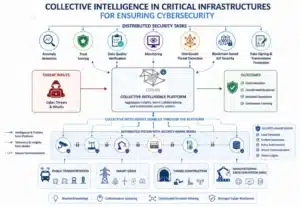
CISSAN’s main objective was to research and develop a platform that leveraged collective intelligence for cybersecurity in IoT (Internet of Things) and OT (Operations Technology) networks. In this model, systems and devices collaborate to detect cyber threats locally and share that information to coordinate a joint incident response.

Councilbox’s technological contribution
Our mission within the consortium was to provide the necessary traceability to guarantee the reliability and robustness of the entire distributed system. To this end, we carry out:
- The development of an immutable event registration system based on Blockchain technology, which integrates anomaly detection capabilities and connects via API with the CISSAN platform.
- The definition of decentralized notarization architectures for IoT networks with high scalability, operating under standards such as PNE 71308 and PNE 71307-2 of Digital Enabling Technologies.
The implementation of a distributed and automated Disaster Recovery use case in collaboration with Arctos Labs, the University of Jyväskylä and Techinova AB.
Project Closure and Legacy
The project was officially closed after the final meeting held in Jyväskylä (Finland).
The project was officially closed after the final meeting held in Jyväskylä (Finland) at the end of April 2026 and was rated with the highest possible rating, “Excellent”.
The main achievements were:
- Development of an innovative cybersecurity platform for the protection of critical infrastructures, which represents a demonstrated improvement in security, performance, scalability and efficiency compared to existing approaches.
- Integration of advanced capabilities such as anomaly detection, data quality verification, confidence scoring, and automated recovery orchestration.
- Using STIX-based threat intelligence sharing to facilitate the detection, prevention, and mitigation of cyberattacks.
- Interoperability with heterogeneous systems through standardised interfaces and common data exchange mechanisms, which allows a gradual evolution of centralised infrastructures towards distributed and collaborative cybersecurity models.
- Incorporation of blockchain-based evidence registration and retrieval to reinforce traceability and trust.
- Creation of an extensible open source framework based on WebAssembly technology.
- Platform validation in realistic transportation environments, smart energy grids, tunnel construction, and manufacturing execution systems.
At the level of research and development, it is worth highlighting the production of 18 scientific publications.
The innovations developed enable organisations to transform legacy centralised systems towards collaborative and resilient networks, taking a critical step towards digital and technological cybersecurity sovereignty for Europe.